
Does pre-emergence herbicides control individual plants and clumps of volunteer corn RR® F2 in soybean?
DOI:
https://doi.org/10.7824/rbh.v15i4.497Keywords:
Glycine max, harvest losses, soybean/corn succession, Zea maysAbstract
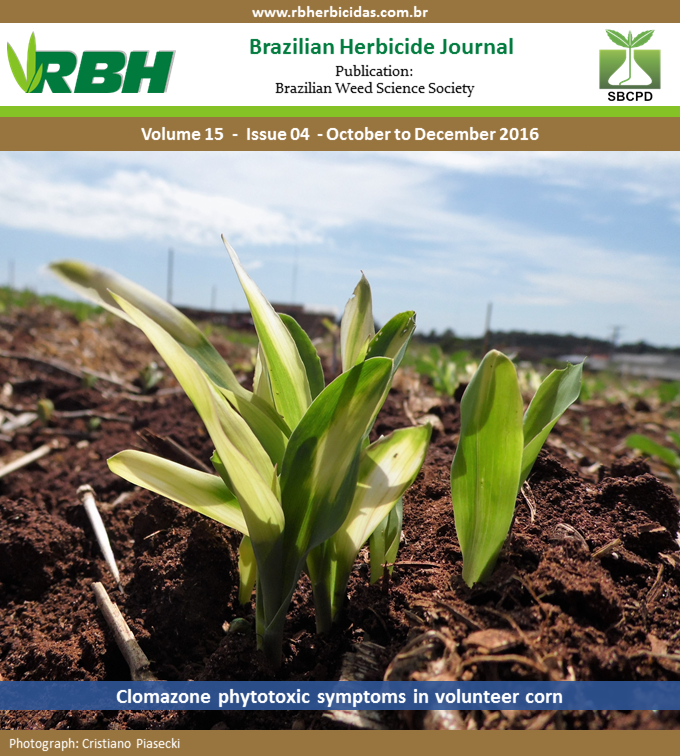
The grown of RR® soybean preceded by corn RR® increased the occurrence of volunteer corn plants interfering with soybeans. The volunteers originate from the grain lost during harvest corn. Losses occur as individual grains, which give rise to individual plants, and in the form of ear corn or pieces containing various grains, which give rise to the clumps. The volunteer corn if not controlled interfere with soybean and reduces significantly the yield, even in a population less than a plant m-2. Pre-emergency herbicides used for weed control in soybean have control effect on volunteer corn RR® F2, however, few studies have demonstrated its efficiency. The objective was to evaluate the control of clumps and individual plants of volunteer corn RR® F2, provided by spraying herbicides chlorimuron (25 g ha-1), diclosulam (25.2 g ha-1), chlorimuron + sulfometuron (18.7 + 18.7 g ha-1), imazapic + imazapyr (78.7 + 26.2 g ha-1), clomazone (360 g ha-1) and pyroxasulfone (119 g ha-1) applied in soybean pre-emergence. Two experiments were carried on field in the design of a randomized block with four replications. The herbicide imazapic + imazapyr was efficient to control clumps while diclosulam, chlorimuron + sulfometuron and imazapic + imazapyr controlled individual plants showing superior control to 80%. Although the results show control of corn, the yield of soybeans decreased in all treatments when compared to control without corn, suggesting that is necessary additional herbicidal post-emergence applications, especially in high infestation of corn.Downloads
Download data is not yet available.
Downloads
Published
2016-12-10
Issue
Section
Weed Management


